
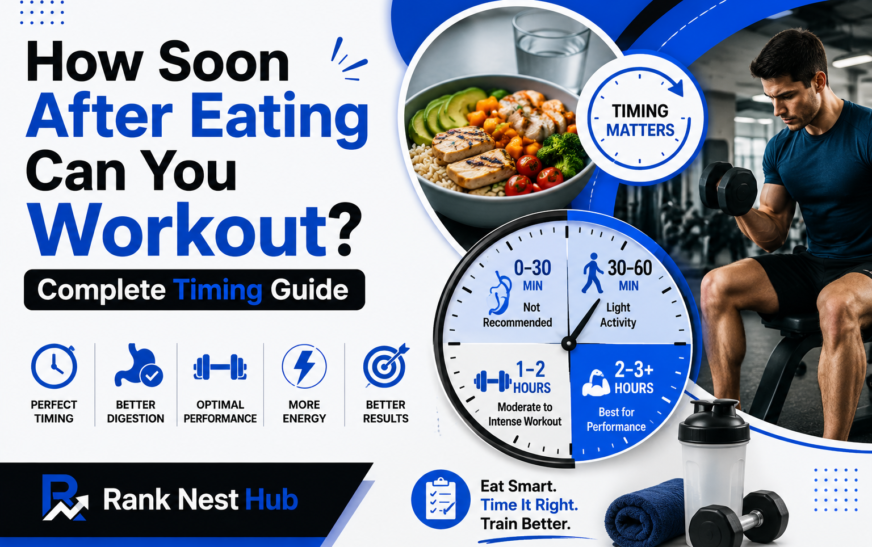
If you are wondering how soon after eating can you workout, there is no single number that works for everyone. In general, a small snack may be comfortable around 30 minutes before exercise, while a normal meal often needs about 1 to 3 hours, and a large meal may require 3 to 4 hours. The right timing depends on what you ate, how much you ate, your workout, and how your body responds.
The goal is not to wait until every last bit of food has been digested. It is to give your stomach enough time to settle so you can exercise comfortably and perform well.
How Soon After Eating Can You Workout?
For most people, these are useful starting points:
- Small snack: around 30 minutes to 1 hour
- Small meal: around 1 to 2 hours
- Moderate meal: around 2 to 3 hours
- Large or heavy meal: around 3 to 4 hours
- Light walking: often possible much sooner, depending on how you feel
Mayo Clinic gives a similar broad framework, recommending large meals around 3 to 4 hours before exercise and smaller meals or snacks around 1 to 3 hours beforehand. It also emphasises that individual tolerance matters.
These are guidelines, not medical rules. Some people can comfortably exercise sooner, while others need more time after the same meal.
Quick Answer: How Long Should You Wait After Eating?
The simplest way to decide is to consider meal size + food type + exercise intensity.
| What you ate | Suggested starting point | Best suited to |
| Very small snack | 15 to 30 minutes | Easy activity |
| Light snack | 30 to 60 minutes | Gym, walking, light cardio |
| Small meal | 1 to 2 hours | Strength training, moderate exercise |
| Moderate meal | 2 to 3 hours | Running, cycling, harder workouts |
| Large or heavy meal | 3 to 4 hours | Intense exercise |
The Academy of Nutrition and Dietetics also notes that pre-workout timing varies between individuals and generally recommends experimenting with a window of roughly one to four hours depending on the activity and personal tolerance.
Why Does Eating Too Close to a Workout Cause Problems?
Your digestive system and your muscles both need your body’s resources when you exercise.
After eating, your digestive system begins processing food and absorbing nutrients. During exercise, your cardiovascular system has to support your working muscles.
If you start a demanding workout while feeling very full, you may experience digestive discomfort.
Common symptoms include:
- Stomach cramps
- Bloating
- Nausea
- Heartburn
- Burping
- Reflux
- A heavy feeling
- Sluggishness
- Side stitches
- Occasionally, vomiting
These symptoms are particularly likely during vigorous activities such as running, cycling and swimming. Research summarised by Healthline also highlights that exercise type, intensity, meal size and food composition can all influence gastrointestinal symptoms.
Does the Size of Your Meal Matter?
Yes. This is one of the most important factors when deciding when to exercise.
A banana and a large takeaway meal are obviously not equivalent. Your body has much more food to process after a large meal, particularly if it contains considerable amounts of fat, protein and fibre.
After a Small Snack
A small, easy-to-digest snack may only need around 30 minutes before exercise.
Examples include:
- Banana
- Toast
- Crackers
- Small cereal bar
- Fruit
- Low-fat yoghurt
If you have a sensitive stomach, you may still prefer more time.
After a Normal Meal
A balanced meal containing carbohydrates, protein and some fat may be more comfortable after around 1 to 3 hours.
For example:
- Chicken and rice
- Pasta with a lean protein
- Oatmeal with yoghurt and fruit
- Sandwich with lean protein
- Potatoes with vegetables and protein
The exact timing depends on portion size and your individual tolerance.
After a Large Meal
A large meal can require considerably more time.
Mayo Clinic recommends allowing 3 to 4 hours after a large meal before exercise. If you have just eaten a very large dinner, jumping straight into sprint intervals or heavy squats is unlikely to be comfortable. Waiting longer is usually the better option.
What You Eat Can Matter as Much as When You Eat
Meal timing is only one part of the equation.
The composition of your food also affects how comfortable you may feel during exercise.
Carbohydrates
Carbohydrates are an important source of energy for exercise.
Foods such as:
- Bananas
- Rice
- Bread
- Oats
- Potatoes
- Pasta
- Fruit
can provide useful pre-workout fuel. The closer you are to exercise, the more important it becomes to choose foods that you personally digest comfortably.
Protein
Protein is important for maintaining and repairing muscle tissue, but a large protein-heavy meal immediately before intense exercise may feel heavy for some people.
If you have several hours before training, protein can comfortably form part of a balanced meal.
Fat
Fat generally takes longer to digest than carbohydrates.
A very high-fat meal shortly before running or high-intensity exercise may therefore increase the chance of stomach discomfort. Mayo Clinic guidance similarly suggests avoiding high-fat foods close to exercise when they cause gastrointestinal problems.
Fibre
Fibre is an important part of a healthy diet, but a large amount immediately before exercise may not suit everyone. High-fibre meals can feel bulky and may increase digestive activity.
If you are about to go for a long run, for example, a very large salad with beans, nuts and other high-fibre ingredients may not be the most comfortable choice.
How Soon After Eating Can You Workout Based on Exercise Type?
The ideal timing changes depending on what you plan to do.
Walking After Eating
Walking is different from high-intensity exercise.
A gentle or moderate walk may be comfortable relatively soon after a meal for many people. The American Heart Association notes that even short walks can be incorporated after meals, including 10-minute walks after breakfast, lunch, and dinner.
If your objective is simply to move after eating, you do not necessarily need to wait several hours. A relaxed walk is much less demanding on your digestive system than sprinting or heavy lifting.
Running After Eating
Running can be harder on the stomach because of the repetitive movement and higher intensity.
For many people:
- Small snack: around 30 to 60 minutes
- Light meal: around 1.5 to 2 hours
- Larger meal: around 2 to 3+ hours
If you experience reflux, cramping,g or nausea when running after meals, increase the gap.
Strength Training After Eating
Strength training can be relatively flexible, but heavy compound movements can create considerable abdominal pressure.
Exercises such as:
- Squats
- Deadlifts
- Leg presses
- Heavy rows
may feel uncomfortable when your stomach is full.
For a normal meal, around 1 to 2 hours may be a reasonable starting point.
For a large meal, give yourself more time.
HIIT After Eating
High-intensity interval training is one of the activities where meal timing can matter most.
HIIT involves repeated periods of hard effort, which can make nausea, reflux,ux and stomach cramps more noticeable.
If you have eaten a substantial meal, waiting around 2 to 3 hours or longer may be more comfortable.
Swimming After Eating
Swimming can also expose digestive discomfort because of body position, movement and intensity.
If you feel full, bloated or uncomfortable, wait longer before swimming hard.
Yoga and Pilates
Gentle yoga may be more forgiving than running or HIIT.
However, poses involving deep twists, forward folds or pressure around the abdomen can feel uncomfortable immediately after eating.
A light snack may be fine relatively close to a session, but a large meal is better several hours beforehand.
What If You Only Have 30 Minutes Before Your Workout?
You do not always have the luxury of planning meals perfectly.
If you have only about 30 minutes before exercising and you are hungry, keep the food simple.
Potential options include:
- Banana
- Small piece of toast
- Fruit
- A few crackers
- Small low-fibre carbohydrate snack
Avoid experimenting with a new food immediately before an important workout.
Mayo Clinic specifically recommends being cautious with unfamiliar foods and drinks before exercise because they may cause an upset stomach.
What If You Have One Hour Before Exercise?
One hour gives you more flexibility.
A small, easily digested meal or snack can work well.
Examples include:
- Banana with a small amount of yoghurt
- Toast with a light topping
- Oats with fruit
- Small smoothie
- Low-fat yoghurt with fruit
Keep the portion moderate.
A large meal is unlikely to become comfortable simply because you have waited 60 minutes.
What If You Have Two Hours Before Your Workout?
Two hours gives you a useful window for a moderate pre-workout meal.
You could consider:
- Chicken with rice
- Oats with yoghurt and fruit
- Pasta with a lean protein
- Potato with lean protein and vegetables
- Wholegrain toast with eggs
Choose foods you already know your body handles well.
What If You Have Three to Four Hours?
This is a much more comfortable window for a substantial meal.
You have enough time to eat a balanced meal containing:
- Carbohydrates
- Protein
- Moderate fat
- Appropriate fibre
- Fluids
This type of meal can be useful before longer or more demanding training.
Mayo Clinic recommends large meals around 3 to 4 hours before exercise.
Can You Workout Immediately After Eating?
You can move immediately after eating, but that does not mean every type of exercise is a good idea.
A short, easy walk may be perfectly manageable for many people.
An intense workout is different.
If you have just finished a large meal, immediately starting:
- Sprint intervals
- Heavy squats
- HIIT
- Fast running
- Intense cycling
may leave you feeling uncomfortable.
The practical rule is simple:
The more demanding the workout and the larger the meal, the more time you should generally allow.
Is It Better to Workout Before or After Eating?
Neither option is automatically better.
It depends on:
- Your training goal
- Workout intensity
- Time of day
- Meal schedule
- Personal preference
- Digestive tolerance
- Total daily nutrition
Some people perform well after eating.
Others prefer training before breakfast or several hours after their last meal.
The American Heart Association also emphasises that consistency matters when choosing when to exercise. The best workout time is often the one you can follow consistently.
Does Working Out After Eating Help With Digestion?
Light movement can be useful after meals, but it is important to distinguish walking from intense training.
A gentle post-meal walk can be easier to tolerate than a hard workout.
The American Heart Association includes short walks after meals as a practical way to build activity into the day.
If your purpose is simply to move after eating, walking may be a better choice than trying to complete a hard gym session immediately.
What Happens If You Workout Too Soon After Eating?
Starting intense exercise too soon may cause temporary digestive symptoms.
You might notice:
Bloating: Your stomach feels unusually full or swollen.
Cramping: Your abdomen may tighten or become painful.
Nausea: Exercise can make an already unsettled stomach feel worse.
Heartburn: Repetitive movement and exercise can aggravate reflux in some people.
Sluggishness: A heavy meal may make you feel slow rather than energised.
Poor workout quality: Discomfort can make it harder to maintain your normal pace or lifting performance.
Healthline’s current review identifies nausea, cramping, heartburn, bloating, regurgitation and burping among symptoms that can occur when exercise follows eating too closely.
What Should You Drink Before a Workout?
Hydration matters just as much as food timing.
Water is usually sufficient for ordinary workouts.
Your needs can increase when:
- Exercise lasts a long time
- You sweat heavily
- The weather is hot
- Training is particularly intense
Mayo Clinic recommends maintaining hydration before, during, and after exercise and notes that sports drinks can be useful for longer sessions where carbohydrate and electrolyte replacement becomes relevant.
Avoid drinking an enormous amount of fluid immediately before exercise.
Instead, hydrate consistently throughout the day.
Do You Need to Eat Before Every Workout?
No.
Not every workout requires a specific pre-workout meal.
For a short, low-intensity session, you may feel perfectly comfortable without eating immediately beforehand.
However, eating can be useful when:
- You are hungry
- Your last meal was several hours ago
- The workout will be long
- The workout will be intense
- You are training for performance
- You need additional energy to complete the session
The Academy of Nutrition and Dietetics notes that individual needs and activity type influence pre-workout nutrition, rather than there being one universal approach.
Can You Exercise on an Empty Stomach?
Some people prefer fasted exercise, particularly in the morning.
Whether this feels good depends on the person and the workout.
You may feel fine during a light session but struggle during longer or more intense training.
Fasted exercise is not automatically better for fat loss, either.
Your overall calorie intake, activity level, nutrition and consistency matter far more than simply whether you trained before breakfast.
If you feel dizzy, weak or unwell while exercising without food, stop and reassess your approach.
What Should You Eat Before a Workout?
There is no universal perfect pre-workout meal.
However, a useful meal generally provides carbohydrates for energy and an appropriate amount of protein.
Good options 2 to 3 hours before
- Oatmeal with fruit and yoghurt
- Rice with chicken
- Pasta with lean protein
- Potato with eggs and vegetables
- Wholegrain sandwich with lean protein
Good options around 30 to 60 minutes before
- Banana
- Fruit
- Toast
- Small smoothie
- Low-fat yoghurt
- Small carbohydrate snack
Your personal tolerance should guide the final choice.
Foods to Be Careful With Before Exercise
Some foods can be more difficult to tolerate immediately before exercise.
These may include:
- Very fatty meals
- Very large portions
- Large amounts of fibre
- Extremely spicy foods
- Foods that personally trigger reflux
- New foods you have never tried before
- Large quantities of alcohol
This does not mean these foods are unhealthy.
It simply means that healthy food is not always ideal immediately before a demanding workout.
How Soon Should You Eat After a Workout?
The other side of the timing question is post-workout nutrition.
After exercise, your body needs nutrients to support recovery. A meal or snack containing carbohydrates and protein can help replenish energy stores and support muscle repair. Mayo Clinic recommends eating a meal containing carbohydrates and protein within about two hours after exercise when possible.
Good options include:
- Greek yoghurt with fruit
- Eggs with toast
- Chicken with rice
- Peanut butter sandwich
- Cottage cheese with fruit
- Recovery smoothie
- Turkey sandwich
You do not need to panic if you cannot eat immediately after your workout.
Your overall nutrition across the day matters.
A Simple Pre-Workout Timing Formula
If you are unsure when to exercise, use this framework:
Large meal + intense workout
Wait around 3 to 4 hours.
Moderate meal + normal workout
Wait around 2 to 3 hours.
Small meal + moderate workout
Wait around 1 to 2 hours.
Small snack + light workout
Around 30 to 60 minutes may work.
Very light activity
You may be able to move sooner if you feel comfortable.
This is a starting framework, not a rigid medical rule.
How to Find Your Personal Workout Timing
Your ideal timing is partly individual.
Try keeping a simple training log.
Record:
- What you ate
- Portion size
- Time you ate
- Time you started training
- Type of exercise
- Workout intensity
- How your stomach felt
- Energy levels
- Workout performance
After several sessions, patterns may become obvious.
Perhaps you discover that you can run comfortably 90 minutes after a light meal but need three hours after a large dinner.
That information is more useful than following a generic rule blindly.
Mayo Clinic similarly recommends paying attention to how your body responds and using experience to guide your eating and exercise habits.
Common Mistakes to Avoid
Eating a Huge Meal Before Training
More food does not automatically mean more energy.
A large meal can leave you uncomfortable.
Exercising Immediately After Dinner
A hard workout immediately after a substantial dinner may cause reflux, cramps, or nausea.
Drinking Too Much Water at Once
Hydration is important, but large quantities immediately before exercise can also feel uncomfortable.
Trying New Foods Before an Important Workout
Save experiments for normal training days.
Assuming Everyone Needs the Same Timing
Your friend’s ideal pre-workout window may not work for you.
Believing You Must Wait Exactly Three Hours
There is no universal rule that says everyone must wait exactly three hours after eating.
The evidence-based guidance provides ranges because individual factors matter.
When Should You Be More Careful?
Most healthy adults can adjust meal timing based on comfort and performance.
However, if you have a medical condition that affects digestion, blood glucose,e or exercise tolerance, personalised advice may be appropriate.
Speak with a qualified healthcare professional if you regularly experience:
- Severe abdominal pain during exercise
- Repeated vomiting
- Fainting or significant dizziness
- Persistent heartburn
- Unexplained exercise intolerance
- Significant blood-sugar problems
- Symptoms that consistently occur after eating and exercising
Do not use a general internet timing guide as a replacement for medical advice tailored to your condition.
Special Note for People Managing Blood Sugar
The relationship between meals and exercise can be particularly important for people who have diabetes or other conditions affecting blood glucose. Exercise can affect blood glucose levels, and the appropriate timing of food, medication and activity may vary significantly.
If you use glucose-lowering medication or have been advised to monitor blood glucose, follow the personalised plan provided by your healthcare team rather than applying a generic pre-workout rule.
The Bottom Line
If you are asking how soon after eating can you workout, start with the size of your meal.
A small snack may work after roughly 30 minutes to an hour. A moderate meal often needs around 1 to 3 hours, while a large meal may be more comfortable after 3 to 4 hours.
Then consider the workout.
A gentle walk can often happen much sooner than a hard run, HIIT session, or heavy lifting workout. Most importantly, listen to your body. If you feel full, nauseous, bloated or uncomfortable, give yourself more time.
The best pre-workout routine is not the one with the most complicated rules. It is the one that gives you enough fuel, keeps your stomach comfortable and allows you to train consistently.
Conclusion
Knowing how soon after eating you can work out is less about following one strict number and more about understanding your meal, your body and your workout.
For most people, small snacks need less time, moderate meals need more, and large meals need the longest gap. Light walking can often be done sooner, while running, HIIT and heavy strength training generally require more consideration.
Start with the general timing ranges, pay attention to how you feel and adjust your routine based on experience. Good workout nutrition should help you feel fuelled, comfortable and ready to train, not overly full or restricted by unnecessary rules.
Want to explore more interesting stories and internet culture? Check out our other articles for more engaging topics and insights.
Frequently Asked Questions
1. How soon after eating can you work out?
How soon after eating you can work out depends on meal size, food composition,n and exercise intensity. A small snack may be suitable around 30 to 60 minutes before exercise, while a moderate meal often needs 1 to 3 hours and a large meal may require 3 to 4 hours.
2. Can I work out 30 minutes after eating?
Yes, depending on what you ate and what exercise you plan to do. Thirty minutes may be reasonable after a small, easily digested snack, particularly for lighter exercise. It is generally less suitable for an intense workout after a large meal.
3. Can I work out one hour after eating?
You can potentially exercise one hour after eating if the meal was small and easy to digest. A large or high-fat meal may still feel uncomfortable after only an hour. Your workout intensity also matters.
4. Is it okay to walk immediately after eating?
Light walking may be comfortable relatively soon after eating for many people. Short walks after meals can also be an easy way to add physical activity to your day.
5. How long should I wait to work out after a large meal?
A useful starting point is 3 to 4 hours after a large meal, particularly before vigorous exercise. Mayo Clinic recommends this general window because larger meals take longer to settle.