

Introduction
Few things are more frustrating than turning your key and hearing nothing but a weak click. A flat battery always seems to happen on a cold morning when you are already late. The good news is that learning how to charge a car battery is straightforward, safe, and something almost anyone can do at home with a basic battery charger and ten minutes of preparation.
In this guide, you will learn exactly how to charge a car battery correctly, how long it takes, which charger to use, and the common mistakes that shorten battery life.
Quick Answer
To charge a car battery, connect a charger’s red clamp to the positive terminal, black clamp to the negative, then switch on and charge for 4 to 12 hours.
What You Need Before You Start
Before touching the battery, gather the right equipment. You will need:
- A battery charger (a smart or trickle charger is ideal for home use)
- Safety glasses and gloves
- A clean cloth and a wire brush for corroded terminals
- Your vehicle handbook, to check battery type and location
Most modern cars use a 12-volt lead-acid battery, though many newer vehicles with stop-start technology use AGM or EFB batteries. These need a compatible smart charger, so check the label on your battery before you begin.
How to Charge a Car Battery Safely: Step by Step
Follow these steps in order. The whole process takes about ten minutes of hands-on work, plus charging time.
Step 1: Turn Everything Off
Switch off the ignition, lights, and all accessories. Remove the key from the vehicle. If your charger requires it, disconnect the battery, always removing the negative (black) terminal first.
Step 2: Inspect and Clean the Battery
Look for cracks, leaks, or swelling. A damaged battery should never be charged; Battery leakage replace it instead. Clean any white or greenish corrosion from the terminals with a wire brush so the clamps make good contact.
Step 3: Connect the Charger
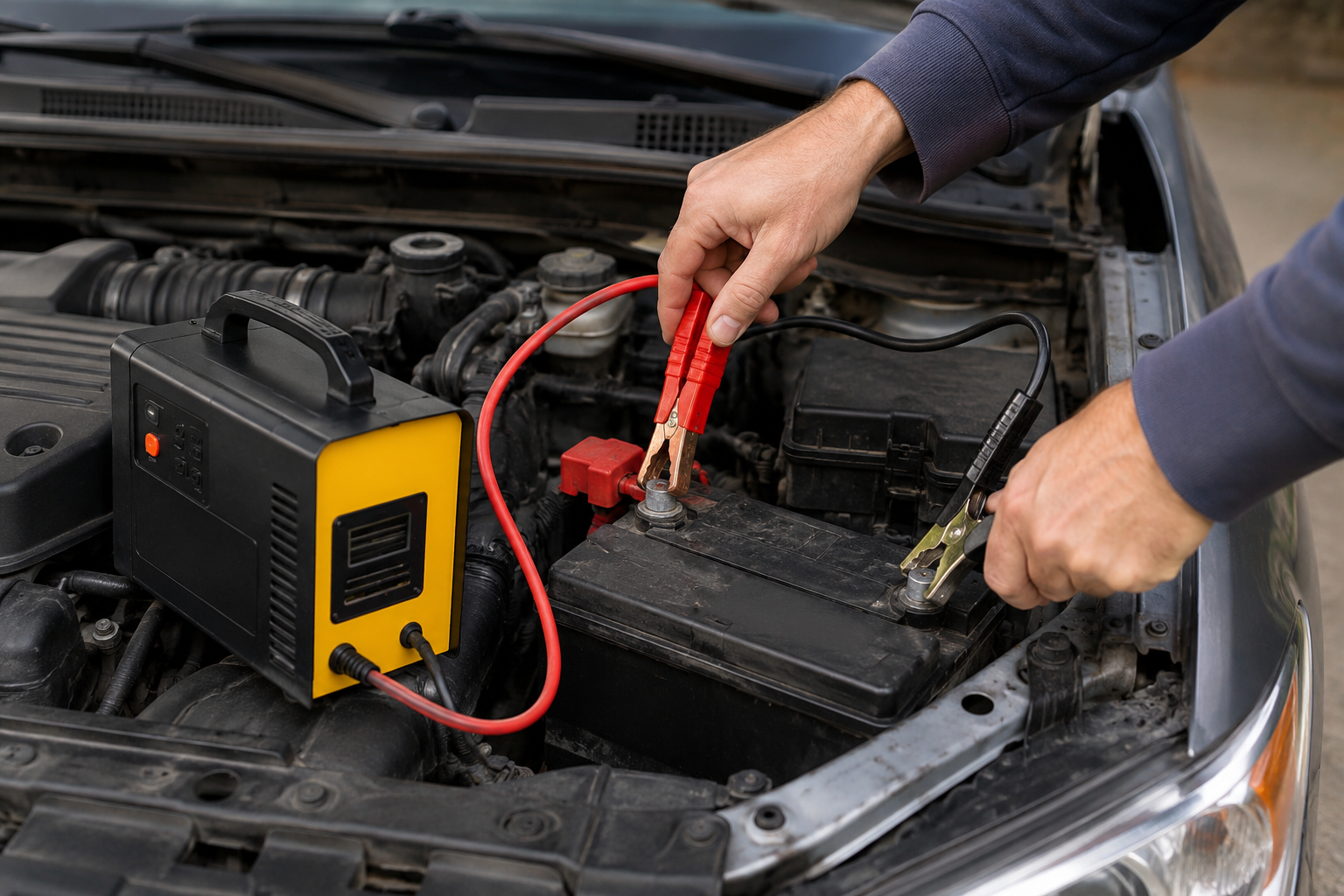
With the charger unplugged, attach the red clamp to the positive (+) terminal, then the black clamp to the negative (-) terminal. Keep the clamps well apart and away from moving parts.
Step 4: Set the Charger and Switch On
Select the correct mode for your battery type (standard, AGM, or gel), then plug in and switch on. Smart chargers do the rest automatically, adjusting the current and stopping when the battery is full.
Step 5: Charge, Then Disconnect in Reverse Order
Let the battery charge fully. When finished, switch off and unplug the charger, remove the black clamp first, then the red. Reconnect the battery to the car if you disconnected it, positive terminal first.
How Long Does It Take to Charge a Car Battery?
Charging time depends on the charger’s output and how flat the battery is.
| Charger type | Typical output | Time for a flat 60Ah battery |
| Trickle charger | 1 to 2 amps | 24 to 48 hours |
| Standard home charger | 4 to 8 amps | 8 to 12 hours |
| Fast charger | 10 to 20 amps | 2 to 4 hours |
| Driving (alternator) | Varies | 30 minutes to top up only |
Slow charging is kinder to the battery. Fast charging is fine occasionally, but repeated high-current charging generates heat and shortens battery life.
Benefits of Charging Your Battery Properly
- Longer battery life: A well-maintained lead-acid battery lasts 4 to 6 years; a neglected one may fail within 2.
- Reliable cold starts: A fully charged battery delivers full cranking power in winter.
- Lower costs: Regular charging avoids premature replacement, which typically costs £80 to £250 in the UK.
- Protects electronics: Modern cars rely on stable voltage for their control units and infotainment systems.
Practical Examples and Real-Life Use Cases
The weekend driver: Sarah uses her car only on Saturdays. Short weekly trips never fully recharge the battery, so it slowly drains. A trickle charger connected overnight once a fortnight keeps it healthy.
The winter commuter: In my own experience running a small workshop, most flat batteries arrive in December and January. Cold weather can cut a battery’s available power by around a third, so a monthly overnight charge through winter prevents most breakdowns.
The stored classic: A car laid up for months will self-discharge. A maintenance charger left permanently connected keeps the battery at full charge without overcharging it.
Latest Trends and Statistics
Battery-related faults remain the single most common cause of vehicle breakdowns in the UK, and recovery organisations consistently report that flat or faulty batteries account for roughly one in five call-outs. Two trends are worth noting for 2026. First, smart chargers with automatic multi-stage charging have largely replaced manual chargers, making home charging far safer. Second, the spread of stop-start systems means AGM and EFB batteries are now common, and these must not be charged with old-style basic chargers.
Common Mistakes to Avoid
- Connecting the clamps the wrong way round, which can damage the charger and the car’s electronics
- Charging a cracked, leaking, or frozen battery
- Using a standard charger on an AGM battery
- Removing clamps while the charger is still switched on, which can cause sparks
- Relying on short journeys to recharge a deeply flat battery, as the alternator cannot fully restore it
Expert Tips
- Charge in a well-ventilated space. Charging releases small amounts of hydrogen gas, so avoid naked flames and smoking nearby.
- If your battery drops below 12.2 volts on a multimeter, charge it soon; below 11.8 volts, it is deeply discharged and needs a slow recovery charge.
- Buy a smart charger with a maintenance mode. It pays for itself the first time it saves a battery.
- If a battery goes flat repeatedly, have the alternator and battery tested. Charging treats the symptom, not the cause.
Key Takeaways
- Connect red to positive first, black to negative, then switch on.
- Slow charging at 4 to 8 amps is safest for battery health.
- A full charge usually takes 8 to 12 hours with a home charger.
- Match the charger mode to your battery type, especially AGM.
- Disconnect in reverse order: black off first, then red.
Conclusion
Knowing how to charge a car battery is one of the simplest and most valuable skills a driver can have. With a smart charger, ten minutes of setup, and a little patience, you can avoid breakdowns, extend Car Fluids battery life, and save money on replacements. Keep a charger in your garage, check your battery before winter, and you will rarely be caught out by that dreaded click again.
Ready to take control of your car’s reliability? Invest in a quality smart charger this week and give your battery a full overnight charge.
Frequently Asked Questions
1.How long does it take to charge a car battery?
A standard 4 to 8 amp home charger takes 8 to 12 hours to fully charge a flat 12-volt car battery.
2.Can I charge a car battery without disconnecting it?
Yes, with a modern smart charger you can usually charge in place, but always check your vehicle handbook first.
3.Which terminal do I connect first when charging?
Connect the red clamp to the positive terminal first, then the black clamp to the negative terminal.
4.Does driving charge a car battery?
Yes, the alternator charges the battery while driving, but short trips cannot fully recharge a deeply flat battery.
5.How do I know when my car battery is fully charged?
A smart charger indicates full charge automatically, or a resting voltage of about 12.6 to 12.8 volts confirms it.