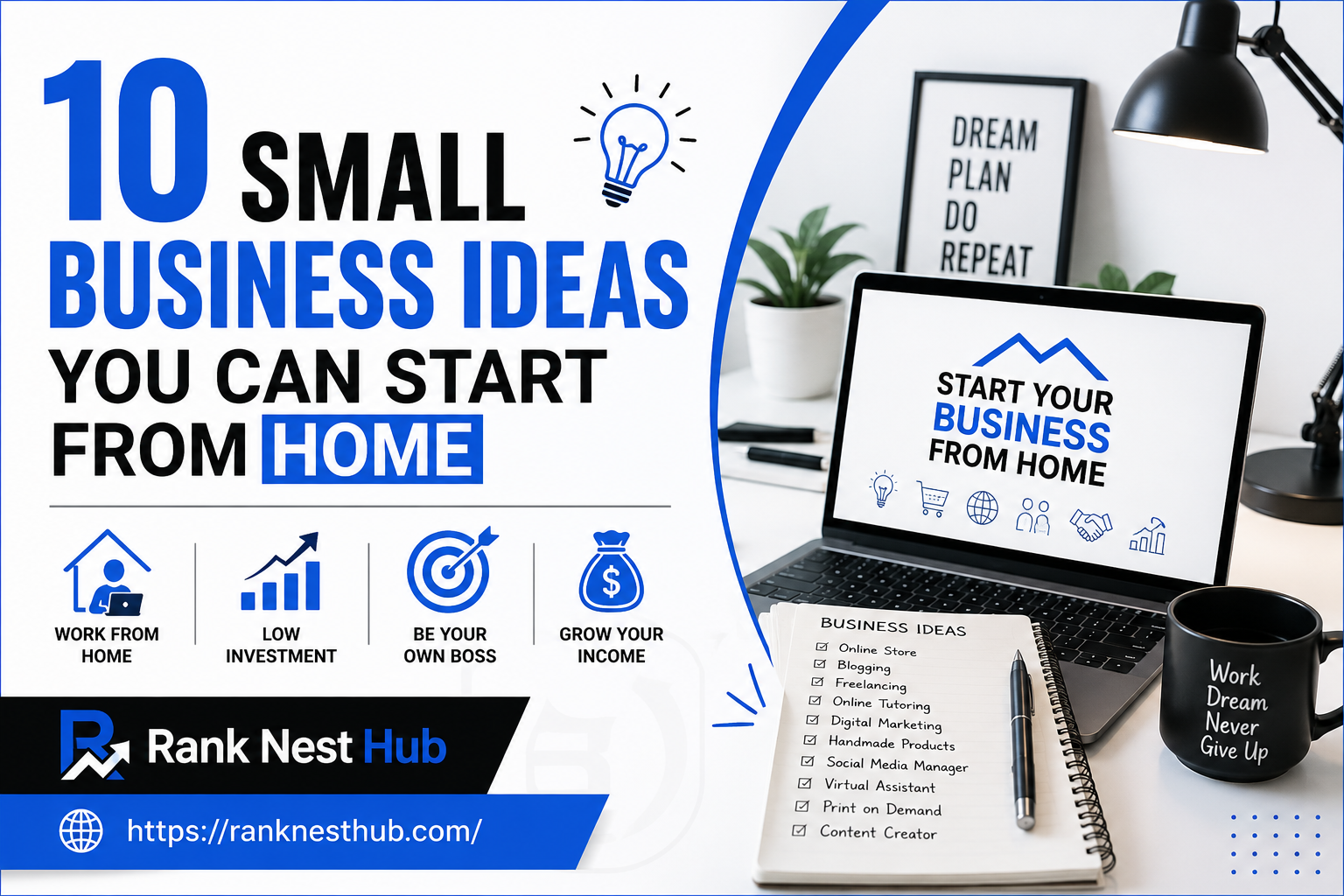

Starting a business does not always require thousands of pounds, a rented office or a large team. Many low cost business ideas can be tested from home or alongside a full-time job with relatively little upfront spending. The real advantage is not simply saving money. An affordable startup plan gives you more time to test demand, learn from customers and improve your offer before committing serious capital.
The smartest low-cost business is not necessarily the cheapest one. It is the one that keeps unnecessary costs low while giving you a realistic path to paying customers, sustainable cash flow and future growth.
What Are Low Cost Business Ideas?
Low cost business ideas are businesses that can be launched with limited upfront capital, low fixed overheads and relatively simple equipment, technology or resources.
They often rely on an existing skill, service, home-based setup, digital tools or direct access to customers rather than expensive premises, large inventories or specialist machinery.
Examples include:
- Freelance writing
- Virtual assistant services
- Social media management
- Online tutoring
- Bookkeeping
- Cleaning services
- Graphic design
- Photography
- Pet care
- Digital products
- Local SEO services
- Home-based food businesses, where permitted
However, “low cost” does not mean “risk-free”.
A business may be inexpensive to launch but expensive to operate if it has high advertising costs, insurance requirements, equipment replacement, delivery expenses, platform fees or regulatory obligations.
That distinction is important when comparing business ideas.
Why Affordable Startup Plans Matter
An affordable startup plan helps you protect your cash while you discover whether people actually want what you are selling.
Many new entrepreneurs make the mistake of spending heavily before making their first sale. They invest in branding, premium software, large quantities of stock, office space and complicated websites before validating the idea.
A lean approach reverses that process.
You test the business first, learn what customers want and then increase spending when there is evidence that the investment can produce a return.
The main benefits include:
- Lower financial risk
- Less pressure to generate immediate revenue
- More flexibility to change direction
- Easier testing of different offers
- Lower monthly overheads
- More control over cash flow
- Greater ability to reinvest early profits
- A safer way to start a side business
The UK government’s business guidance also recommends testing and validating a business idea, considering profitability and understanding your finances before committing to a full launch.
The Best Low Cost Business Ideas Are Usually Lean
A useful way to judge an idea is to ask:
What do I actually need to spend before someone can pay me?
If the answer is a laptop, internet connection, basic software and your existing expertise, the idea may be naturally lean.
If the answer includes a commercial property, thousands of pounds of inventory, specialist equipment and several employees, it is not necessarily a low-cost startup, even if the business model sounds attractive.
This is why service businesses are often appealing to first-time entrepreneurs.
You can sell expertise or labour before building a large operation around it.
12 Low Cost Business Ideas to Consider
The right option depends on your skills, available time, local demand and financial situation. Treat the following as business models to investigate rather than guaranteed income opportunities.
1. Freelance Writing and Content Services
If you have strong writing skills, freelance content creation can be started with very little equipment.
You could offer:
- Blog writing
- Website copy
- Product descriptions
- Email newsletters
- SEO content
- Editing and proofreading
A niche approach can make the service easier to market. Instead of presenting yourself as a writer for everyone, you could specialise in areas such as technology, finance, property or healthcare.
Why it can be low cost: You can begin with equipment you already own and sell your expertise rather than physical products.
Main challenge: Finding consistent clients and building a reliable pipeline.
2. Virtual Assistant Services
Small businesses often need help with administration but may not want to employ someone full-time.
A virtual assistant could handle:
- Email management
- Appointment scheduling
- Data entry
- Customer support
- Research
- Document preparation
- Basic social media tasks
The model can start as a one-person service and later develop into a small agency.
Best for: Organised people with strong communication and administrative skills.
3. Local SEO Services
Local businesses need to be visible when potential customers search for nearby services.
A small local SEO service could focus on:
- Google Business Profile optimisation
- Local keyword research
- Citation management
- Website content
- Review strategies
- Local landing pages
- Basic technical SEO
This can be attractive because you are selling expertise rather than stock.
4. Social Media Management
Many small businesses understand that social media matters but do not have enough time to manage it consistently.
A social media manager might provide:
- Content calendars
- Captions
- Short-form videos
- Basic graphics
- Scheduling
- Community management
- Performance reporting
You can begin with one niche, such as restaurants, beauty businesses, tradespeople or professional services.
Potential advantage: Monthly retainers can create more predictable revenue than one-off projects.
5. Online Tutoring
Tutoring can be a particularly accessible business model for people with strong knowledge in a specific subject.
Possible areas include:
- Maths
- English
- Languages
- Science
- Coding
- Exam preparation
- Business skills
You can provide sessions online, although the platforms, safeguarding requirements and qualifications you need may vary depending on your service and location.
6. Bookkeeping and Administrative Support
Small businesses frequently need help keeping their financial records organised.
If appropriately trained and qualified, you could offer bookkeeping or administrative support to small firms.
Possible customers include:
- Tradespeople
- Consultants
- Freelancers
- Small retailers
- Professional service firms
This type of business can become recurring because clients often need support every month.
However, financial services require greater attention to accuracy, professional standards and relevant regulations than many general freelance services.
7. Cleaning Services
Cleaning is a traditional low-cost business model because you can start relatively small and build your customer base locally.
Possible niches include:
- Domestic cleaning
- Office cleaning
- End-of-tenancy cleaning
- Holiday-let cleaning
- Deep cleaning
You should calculate the complete cost of supplies, transport, insurance, marketing and your own working time before setting prices.
A service that looks profitable at first can become unattractive if travel time and operating expenses are ignored.
8. Pet Care Services
Pet sitting, dog walking and related services can be started on a small scale.
The advantage is that customers may purchase services repeatedly rather than making a single purchase.
Before launching, research:
- Local demand
- Competitor pricing
- Insurance
- Animal welfare requirements
- Licensing or registration requirements where applicable
- Transport requirements
Regulations can differ depending on the exact service you provide.
9. Graphic Design
Graphic design is another skill-based business that does not necessarily require physical premises.
You could create:
- Social media graphics
- Business brochures
- Presentation designs
- Brand assets
- Marketing materials
- Website graphics
A portfolio is often more valuable at the beginning than expensive branding for your own business.
Build examples that demonstrate the type of work you want clients to purchase.
10. Digital Products
Digital products can include:
- Templates
- Guides
- Checklists
- Spreadsheets
- Educational resources
- Design assets
- Digital planners
The main attraction is that you can create a product once and potentially sell it multiple times.
However, digital products are not automatically easy to sell.
The biggest challenge is usually customer acquisition. A great product still needs a clear audience, useful positioning and a reliable marketing channel.
11. Photography and Content Creation
If you already own suitable equipment and have photography or video skills, you can turn those skills into a service business.
Possible niches include:
- Product photography
- Property photography
- Food photography
- Social media content
- Small business videos
- Event photography
Starting with a specific niche can make it easier to build a portfolio and communicate your value.
12. Online Reselling
Reselling can be started on a small scale by purchasing or sourcing products and selling them through suitable marketplaces.
The key challenge is inventory risk.
Before buying large quantities, test:
- Product demand
- Selling prices
- Platform fees
- Shipping costs
- Return rates
- Supplier reliability
- Profit margins
A product can have a healthy selling price but still produce little profit after all costs are deducted.
How to Decide Which Low Cost Business Idea Is Right for You
Choosing a business should involve more than asking which idea sounds profitable.
Use five questions.
1. What skills do I already have?
Existing skills can reduce training costs and shorten the time needed to reach your first customer.
2. What problem can I solve?
People rarely pay simply because you have a business.
They pay because you solve a problem, save them time, provide convenience or deliver a result they value.
3. Who is the customer?
Avoid targeting “everyone”.
A specific customer group makes your offer, pricing and marketing easier to develop.
4. How will I get my first 10 customers?
This question is often more important than asking how you will get 10,000 customers.
Consider:
- Personal networks
- Local businesses
- Referrals
- Social media
- Local search
- Marketplaces
- Partnerships
- Direct outreach
5. What happens if sales are slow?
Choose a model that does not create dangerous fixed costs before revenue becomes predictable.
A Simple Startup Cost Framework
Do not look only at the initial purchase price.
Think about startup costs in four categories.
| Cost category | Examples |
| Essential setup | Equipment, domain, software, registration |
| Operating costs | Transport, supplies, subscriptions, insurance |
| Customer acquisition | Advertising, networking, sales tools |
| Contingency | Repairs, replacements and unexpected costs |
For example, a cleaning business may initially appear inexpensive because the equipment is basic. But the real budget may also need to include transport, insurance, cleaning supplies, marketing and replacement equipment.
This is why total startup cost and monthly operating cost should be considered separately.
Hidden Costs That Beginners Often Miss
One of the biggest gaps in generic low-cost business lists is that they can make an idea appear cheaper than it really is.
Before spending money, investigate these hidden costs.
Insurance
Depending on the activity, you may need business insurance or professional cover.
Do not assume your existing home or personal insurance automatically covers business activities.
If you operate from home, GOV.UK notes that you may need permission or separate insurance, and your home insurance may not cover business-related risks.
Software subscriptions
A £10 or £20 monthly subscription may not seem significant.
But several subscriptions can quickly become a meaningful monthly expense.
Review every recurring payment regularly.
Marketing
A website does not automatically generate customers.
You may need to invest time or money into:
- SEO
- Social media
- Networking
- Advertising
- Partnerships
- Email marketing
Transport
Local service businesses should calculate fuel, parking, vehicle maintenance and travel time.
Taxes and accounting
Revenue is not the same as profit.
You need to track income and allowable business expenses accurately.
HMRC states that self-employed people must keep records of business income and expenses for Self Assessment.
Licences and permits
Some businesses require specific permissions.
The UK government’s licence finder covers hundreds of potential licences and permissions, depending on the activity and location.
How to Start a Low Cost Business Without Overspending
A lean launch can follow this sequence.
Step 1: Choose one specific customer
Instead of “I want to offer marketing”, define the customer.
For example:
“I help local trades businesses improve their online visibility.”
A clear customer makes your offer easier to explain.
Step 2: Identify one painful problem
Find something customers already spend money to solve.
The strongest opportunities often involve:
- Saving time
- Increasing revenue
- Reducing costs
- Improving convenience
- Solving a recurring problem
Step 3: Create a simple offer
Do not build ten services at once.
Start with one clearly defined service or product.
Step 4: Validate before investing heavily
Speak to potential customers.
Ask:
- What are they currently doing?
- What is frustrating about it?
- What have they already tried?
- What would they pay for a better solution?
Then look for actual buying behaviour, not just compliments.
Step 5: Make the first sale
A paying customer provides stronger validation than hundreds of social media likes.
Step 6: Reinvest carefully
Once revenue starts appearing, reinvest in areas that can improve:
- Customer experience
- Delivery
- Marketing
- Productivity
- Capacity
- Quality
Avoid spending simply because the business has made its first few sales.
Why Validation Is More Important Than a Big Startup Budget
A large budget cannot fix weak demand.
If customers do not want your product or service, spending more money generally increases the amount you can lose.
Validation reduces this risk.
For example, imagine someone wants to launch an online stationery shop.
A high-spending approach might involve:
- Buying £3,000 of stock
- Building an expensive website
- Paying for professional branding
- Running advertisements
- Discovering that customers prefer a different product range
A lean approach could involve:
- Researching demand
- Identifying a narrow product category
- Testing a small selection
- Creating simple product pages
- Getting initial customer feedback
- Reordering only proven products
The second approach may grow more slowly, but it limits unnecessary exposure.
Low Cost Does Not Mean Low Risk
This is one of the most important distinctions for new entrepreneurs.
A £100 business can still fail.
A £10,000 business can still succeed.
The amount invested is only one part of the equation.
Consider these risks:
- Weak market demand
- Poor pricing
- Strong competition
- Unreliable suppliers
- High customer acquisition costs
- Low profit margins
- Legal or regulatory problems
- Founder burnout
- Unpredictable cash flow
The objective should therefore be controlled risk, not simply the lowest possible cost.
Low Cost Business Ideas: Which Models Usually Have the Lowest Overheads?
| Business model | Typical cost profile | Inventory risk | Scalability |
| Freelancing | Very low | Very low | Medium |
| Virtual assistance | Very low | Very low | Medium |
| Online tutoring | Low | Very low | Medium |
| Local SEO | Very low | Very low | High |
| Social media management | Low | Very low | High |
| Cleaning | Low | Low | Medium |
| Pet care | Low | Very low | Medium |
| Graphic design | Very low | Very low | High |
| Digital products | Low | Very low | High |
| Reselling | Medium | Medium to high | Medium |
| Photography | Medium if equipment is owned | Very low | Medium |
| Food business | Medium | Medium | Medium |
These are comparative categories rather than guaranteed costs. Actual expenses vary by location, equipment, business structure and service requirements.
Service Business vs Product Business
If your priority is keeping initial costs low, service businesses often have a structural advantage.
Service business
You sell:
- Time
- Expertise
- Labour
- Convenience
- Professional knowledge
You generally do not need to purchase large amounts of inventory before making sales.
Product business
You may need to pay for:
- Inventory
- Packaging
- Storage
- Shipping
- Returns
- Product development
- Payment processing
This does not mean product businesses are bad.
It simply means they can expose more cash to inventory and operational risk.
How to Build a £500 Startup Budget
A small budget should have a job.
Instead of spending the entire amount immediately, divide it into priorities.
Example lean budget
£0 to £100:
Basic tools, domain, essential software or initial supplies.
£100 to £200:
Insurance, equipment upgrades or professional essentials where required.
£100 to £150:
Customer acquisition and testing.
£50 to £100:
Emergency or contingency reserve.
The exact allocation should depend on the business.
The principle is more important than the numbers:
Do not spend your entire budget before you understand what creates sales.
UK Considerations Before Starting a Low Cost Business
If you are starting in the UK, affordability should not mean ignoring compliance.
The government-backed guidance explains that your business structure affects taxation, responsibilities and how business debts are handled.
You may operate as a sole trader, limited company or another structure depending on your circumstances.
For sole traders, GOV.UK says registration for Self Assessment is generally required when gross trading income exceeds £1,000 in a tax year, although there are circumstances where registration may be required for other reasons.
The £1,000 trading allowance is also important, but it should not be interpreted as meaning that all business activity below £1,000 is automatically free from every obligation. HMRC provides specific rules and exceptions.
You should also check whether your business needs:
- A licence
- Planning permission
- Professional registration
- Business insurance
- Food registration
- Data protection compliance
- Special sector permissions
Requirements vary by business and location.
How to Make a Low Cost Business More Profitable
Keeping costs low is only half the strategy.
You also need to improve the value of each sale.
Increase your average order value
Offer relevant add-ons or packages.
Focus on repeat customers
Recurring revenue can make cash flow more predictable.
Specialise
A specialist can often communicate value more clearly than a generalist.
Improve your processes
Templates, automation and standard operating procedures can reduce the amount of time required per customer.
Track your numbers
Monitor:
- Revenue
- Gross profit
- Operating expenses
- Customer acquisition cost
- Average order value
- Repeat purchase rate
- Monthly recurring revenue
- Cash available
A low-cost business becomes much stronger when the owner understands these numbers.
A Simple Decision Matrix for Choosing Your Business
Score each potential idea from 1 to 5.
| Factor | Score |
| Existing skills | /5 |
| Customer demand | /5 |
| Startup affordability | /5 |
| Low ongoing costs | /5 |
| Profit margin potential | /5 |
| Repeat customer potential | /5 |
| Ease of finding customers | /5 |
| Scalability | /5 |
| Regulatory simplicity | /5 |
Add the scores.
An idea that looks exciting but scores poorly across several categories deserves more research before you invest.
This approach is more useful than simply choosing the business with the lowest advertised startup cost.
Common Mistakes to Avoid
Spending too much on branding
Your first priority should be proving that customers want the offer.
Buying too much stock
Test demand before committing large amounts of money to inventory.
Underpricing
Low prices do not automatically create a profitable business.
Ignoring your own time
If a £50 job takes four hours including travel and administration, the headline price is misleading.
Depending entirely on one platform
A business built entirely around one marketplace or social network can become vulnerable if fees, algorithms or policies change.
Forgetting taxes and records
Keep business records from the beginning. HMRC requires self-employed people to maintain records of income and expenses.
Scaling before validation
Do not hire people, rent premises or purchase large amounts of equipment simply because the first few sales went well.
The Best Low Cost Business Idea Is the One You Can Validate
There is no universally best business idea.
The best option for one person may be completely unsuitable for another.
A skilled designer may have an excellent opportunity in freelance design. Someone with strong organisational skills may be better suited to virtual assistance. A person with specialist academic knowledge may have a strong tutoring opportunity.
Your advantage is usually found where these three things overlap:
Your skills + customer demand + affordable delivery.
That is a more reliable framework than chasing whatever business idea happens to be trending.
Final Thoughts
The real value of low cost business ideas is not simply that they require less money.
Affordable startup plans give entrepreneurs room to experiment, make mistakes, understand their customers and improve their business without putting excessive capital at risk.
The strongest approach is to start with a real customer problem, create a simple offer, validate demand, track every important cost and reinvest only when the numbers support it.
If you are considering starting a business in 2026, do not ask only, “What is the cheapest business I can start?”
Ask a better question:
“What business can I test affordably, sell profitably and grow sustainably?”
That shift in thinking can turn a cheap startup idea into a serious business opportunity.
For more helpful insights, explore our latest articles and discover new ways to grow your business online.
Frequently Asked Questions
What are the best low cost business ideas?
Some of the most accessible options include freelancing, virtual assistance, online tutoring, local SEO, social media management, cleaning, pet care, graphic design and digital products. The best choice depends on your skills, target market, operating costs and ability to find customers.
Can I start a business with very little money?
Yes. Some service-based and digital businesses can be tested with minimal upfront spending, particularly if you already have the required skills and equipment. However, you should still budget for operating costs, marketing, taxes, insurance and any licences that apply to your activity.
Are low cost business ideas profitable?
They can be, but low startup costs do not guarantee profitability. Profit depends on pricing, demand, margins, operating expenses, customer acquisition and how efficiently the business is managed.
What is the cheapest business to start?
Skill-based services are often among the cheapest because they can require little or no inventory. Examples include freelance writing, virtual assistance, tutoring and some digital marketing services. The actual cost depends on the tools, qualifications and regulations required.
How do I choose the right low cost business idea?
Start by evaluating your existing skills, available budget, customer demand, competition, expected operating costs and route to your first customers. Test the idea on a small scale before making a larger investment.